
Spiritualism and culture
Hilma af Klint, the painter of the séances
Before Kandinsky, a Swedish painter reached abstraction guided by the spirits she communicated with in a group of five women, and asked that those paintings not be shown for twenty years.

Hilma af Klint was born in 1862 at Solna, near Stockholm, into a family of naval officers. She studied at the Royal Academy of Fine Arts and became a respected painter of landscapes and portraits. But beside that official life she led another, which remained hidden for decades: from the mid-1880s she took part in séances, and from those séances came a painting unlike anything that existed.
The Five
In 1896 Hilma formed with four friends a group called De Fem, "The Five". They met every week, prayed, read the Bible and held séances in which they received messages from entities they called "the High Masters". The communications came through automatic writing and drawing: the women let their hands run over the paper, and floating forms, spirals and overlapping lines emerged. Their notebooks survive and document almost ten years of work.
The paintings for the Temple
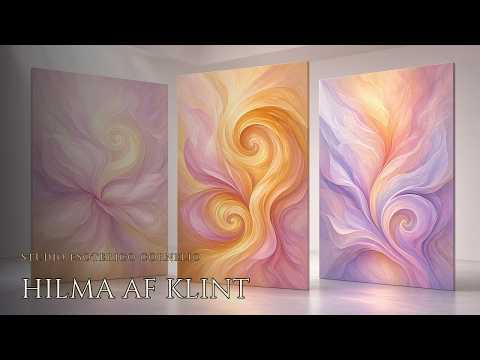
In 1904 the guides announced a commission to Hilma: to paint a series of works intended for a temple. Between 1906 and 1915 she produced the Paintings for the Temple, nearly two hundred works. Among them are The Ten Largest, canvases more than three metres high representing the ages of human life with organic forms, petals, spirals and letters, in luminous pastel colours. They were abstract as early as 1907, some years before Kandinsky's first abstract works.
The meeting with Steiner
In 1908 Hilma invited Rudolf Steiner, then head of the German section of the Theosophical Society, to see her paintings. Steiner was struck but discouraged her: no one, he told her, would understand them for at least fifty years. The painter stopped painting for four years. Later she drew close to anthroposophy and changed her way of working, less guided by the spirits and more deliberate.
Twenty years of waiting
Before her death in 1944, Hilma af Klint left instructions that her esoteric works were not to be shown for at least twenty years after she died. The world, she thought, was not ready. The paintings stayed in crates until the 1980s; their exhibition, culminating in the great Guggenheim show in New York in 2018, has forced a rewriting of the history of abstraction.
Spiritualism and modern art
Hilma af Klint's story shows how much spiritualism, born with the raps of Hydesville and the turning tables, nourished twentieth-century culture: not only séances and phenomena, but a new idea of the image, able to make visible what cannot be seen.
Watch the video
Sources and further reading
- H. af Klint, notebooks of the séances of "The Five" (1896-1906), Hilma af Klint Foundation
- I. Müller-Westermann (ed.), Hilma af Klint. A Pioneer of Abstraction (Moderna Museet, 2013)
- T. Bashkoff (ed.), Hilma af Klint. Paintings for the Future (Guggenheim, 2018)
- J. Voss, Hilma af Klint. A Biography (2020, Eng. trans. 2022)
Read next

Madame Blavatsky and the Theosophical Society
Born among the American spiritualists, Helena Blavatsky's Theosophical Society turned talk with the dead into a doctrine of Masters, cosmic evolution and the wisdom of the East.
Arthur Conan Doyle, the creator of Sherlock Holmes among the spirits
The inventor of the most rational detective in literature devoted the last fifteen years of his life to the cause of spiritualism, between lectures, books and the Cottingley fairies.

Hydesville 1848: the Fox sisters and the birth of spiritualism
A wooden house in New York State, two young girls, mysterious knocks in the dark and an alphabet for talking with the dead: the night of 31 March 1848 that gave birth to the spiritualist movement.
