
Origins and phenomena
Table-turning: the craze that conquered Europe
In 1853 drawing rooms all over Europe gather around little tables that turn, tilt and knock out words. Faraday puts them to the test, Chevreul explains them, and the planchette is born.
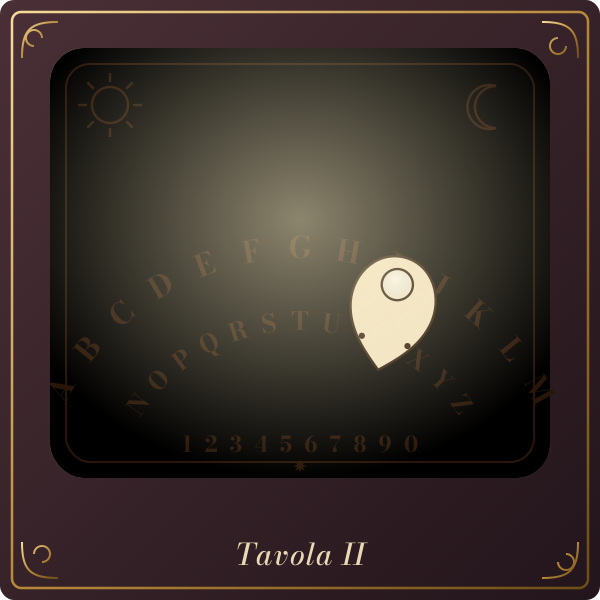
In the spring of 1853 a new passion swept across Europe like an epidemic. Starting from the United States, where the Fox sisters had made spirit knocks famous, it reached the German ports and from there spread to France, England and Italy. In middle-class and aristocratic drawing rooms, after dinner, guests sat around a small table, laid their hands on the top, linked little fingers to form a chain and waited. After a few minutes the table began to move.
How a table “spoke”
At first the table turned, slid, rose on one leg. Then the sitters discovered that it could answer: one knock for yes, two for no, or one knock for each letter of the alphabet, until words and sentences were spelled out. This method was called typtology, from the Greek for “to strike”. Séances lasted for hours and produced messages attributed to dead relatives, historical figures and mysterious entities. On Jersey, Victor Hugo and his family filled whole notebooks with them.
Faraday puts it to the test
The English physicist Michael Faraday, the great student of electricity, decided to investigate. The phenomenon was widespread enough to worry him: many attributed it to electricity or magnetism, fields in which he was the leading expert. In June 1853 he built a simple device: two boards one on top of the other, separated by rollers, with a pointer that showed the slightest movement of the upper board relative to the lower one. The results, published in The Times and The Athenaeum, were clear: it was the sitters' hands that pushed the table, without their realising it. When they could see the indicator, the table stopped moving.
The movement we do not know we make
Faraday relied on an idea worked out a few months earlier by the physiologist William Carpenter: ideomotor action, the capacity of an idea or expectation to produce small, involuntary muscular movements. In France the chemist Michel-Eugène Chevreul, who as a young man had already studied the exploring pendulum, devoted a book in 1854 to the divining rod, the pendulum and turning tables, reaching similar conclusions. The pendulum swinging over a map and the tilting table obey, according to this explanation, a single law.
From table to planchette
The craze did not stop in the face of scientific explanations. On the contrary, it was refined. In that same year 1853 the planchette appeared in France: a heart-shaped board on small castors, with a pencil fixed at its tip, on which the sitters rested their fingers so that it would “write” by itself. Thus the spirits' automatic writing was born. At the end of the century the planchette was combined with a board bearing the letters of the alphabet, numbers and the words yes and no: the talking boards, patented and sold as a parlour game in the United States from 1890.
Game, science, religion
Table-turning was at once a society pastime, a subject of scientific inquiry and the first step towards a new religiosity. For many it was a game; for others, the start of a road that led to the books of Allan Kardec and to faith in dialogue with the dead. The Catholic Church warned the faithful, but could not stop the fashion. Even today, in many families, people tell of a grandfather or great-grandmother who, as young people, “used to make the table turn”.
Watch the video

Sources and further reading
- M. Faraday, letter to The Times (30 June 1853)
- M. Faraday, Experimental Investigation of Table-Moving, The Athenaeum (2 July 1853)
- M.-E. Chevreul, De la baguette divinatoire, du pendule dit explorateur et des tables tournantes (1854)
- W. B. Carpenter, On the Influence of Suggestion in Modifying and Directing Muscular Movement (1852)
Read next
Hydesville 1848: the Fox sisters and the birth of spiritualism
A wooden house in New York State, two young girls, mysterious knocks in the dark and an alphabet for talking with the dead: the night of 31 March 1848 that gave birth to the spiritualist movement.
Spirit photography
A Boston engraver, a plate with a transparent face, the portrait of Lincoln's widow, fraud trials and fairies in an English garden: how photography promised to make the invisible visible.
Mesmer and animal magnetism
A Viennese physician, a tub with iron rods, the convulsive crises of Parisian salons and a commission with Franklin and Lavoisier: animal magnetism prepared the ground for the spirits.
